Carnival is an annual celebration of life found in many countries of the world. And in fact, by learning more about carnival we can learn more about ourselves and a lot about accepting and understanding other cultures. (Click on featured blog photo see full view)
African influences on carnival traditions: Important to Caribbean festival arts are the ancient African traditions of parading and moving in circles through villages in costumes and masks. Circling villages was believed to bring good fortune, to heal problems, and chill out angry relatives who had died and passed into the next world. Carnival traditions also borrow from the African tradition of putting together natural objects (bones, grasses, beads, shells, fabric) to create a piece of sculpture, a mask, or costume — with each object or combination of objects representing a certain idea or spiritual force.
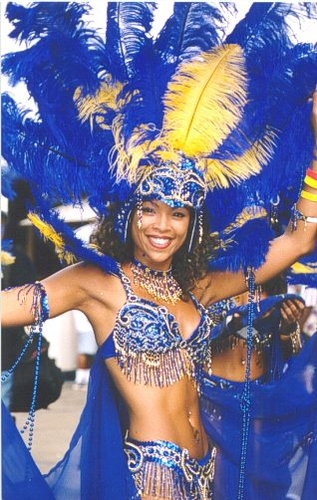
Feathers were frequently used by Africans in their motherland on masks and headdresses as a symbol of our ability as humans to rise above problems, pains, heartbreaks, illness — to travel to another world to be reborn and to grow spiritually. Today, we see feathers used in many, many forms in creating carnival costumes. African dance and music traditions transformed the early carnival celebrations in the Americas, as African drum rhythms, large puppets, stick fighters, and stilt dancers began to make their appearances in the carnival festivities.
In many parts of the world, where Catholic Europeans set up colonies and entered into the slave trade, carnival took root. Brazil, once a Portuguese colony, is famous for its carnival, as is Mardi Gras in Louisiana (where African-Americans mixed with French settlers and Native Americans). Carnival celebrations are now found throughout the Caribbean in Barbados, Jamaica, Grenada, Dominica, Haiti, Cuba, St. Thomas, St. Marten; in Central and South America in Belize, Panama, Brazil; and in large cities in Canada and the U.S. where Caribbean people have settled, including Brooklyn, Miami, and Toronto. Even San Francisco has a carnival!
The Birth of the Steelband: One of the exciting aspects of Caribbean carnival is the appearance in the early 20th century of the steel pan, which are instruments made from used oil drums that have been cut off on one end and then shaped, pounded, and tuned. Every carnival season, steelbands, composed of one to two hundred pan players, practice for months on end. Ready with their tunes, these steelbands take to the stadiums and the streets, to create some of the most beautiful music in the world.
The history of the steelband in Trinidad and Tobago is directly tied to the banning of all types of drumming in Trinidad in the 1880’s. Though this ban was not readily accepted and rioting resulted, ultimately Africans applied and readapted their tradition of the drum to create new forms and mediums of music, including the tamboo bamboo, a rhythmic ensemble made up of bamboo joints beaten together and pounded on the ground. Biscuit tins and dustbins were manipulated and crafted into instruments, becoming the first “pans.” To explore the roots of pan and understand that this phenomenal music came about through years of struggle and sacrifice.
Carnival in Trinidad and Tobago: Trinidad's carnival is a beautiful example of how carnival can unite the world [... ] Read More About the History of Carnival at
www.allahwe.org
 Posted By: Jen Fad
Monday, February 20th 2012 at 12:06PM
You can also
click
here to view all posts by this author...