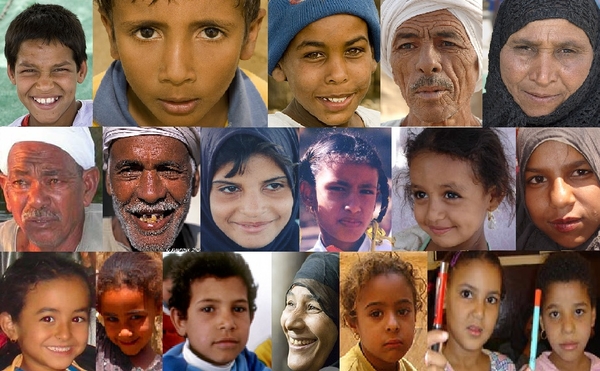
...Their responses led me to contemplate the conceptual Sahara divide. For centuries, the Sahara Desert has been viewed as a vast impenetrable barrier dividing our continent into two distinct areas : Northern “white” and sub-Saharan “black” Africa. The countries south of the Sahara have long been considered authentically “African” while those to the north have been perceived as Mediterranean, Middle Eastern or Islamic. While most anthropologists refute this perception of Africa as “inaccurate”, it has nevertheless, influenced the way people think about the continent and our region in particular. Apparently, it has also impacted the way Egyptians view themselves. Many Egyptians are oblivious to their “African-ness “, failing to identify themselves as Africans. When confronted with the reality of their African roots, some Egyptians are stunned, others reluctant to acknowledge the fact. Though I hate to admit it, we are a racist people.
African refugees living in Egypt often complain of discrimination and verbal and physical harassment on the streets. Egyptians look down on darker-skinned sub-Saharans as their “inferiors,” they claim. Historian Jill Kamel confirms this, explaining that it may be attributed to the fact that across generations, Egypt’s elite community was made up mostly of lighter-skinned Egyptians whereas the underprivileged Egyptians were those toiling under the hot sun to earn their bread. ”Egyptians have thus come to associate fair skin with elitism,” she said.
The nationalist pan-Arabism ideology promoted by the late President Gamal Abdel Nasser in the fifties and sixties led his supporters (the Nasserists) to take pride in their Arab identity. The notion of pan- Arabism gained wider acceptance in the seventies when, in the wake of the Gulf oil boom, millions of Egyptians traveled to oil-rich Gulf states to earn their livelihoods. They adopted many of the habits of the host countries, bringing home a new conservatism which was reflected in their style of dress and mannerisms. Author and writer Galal Amin discusses the impact of Wahhabism, a rigid form of Islam practiced in Saudi Arabia, on Egyptian culture at length in his book “Whatever Happened to the Egyptians” a two-part series that chronicles the changes brought about by the mass exodus to the Gulf in the seventies.
- See more at:
http://www.dailynewsegypt.com/2012/09/06/a...
 Posted By: Jen Fad
Wednesday, April 23rd 2014 at 12:11AM
You can also
click
here to view all posts by this author...